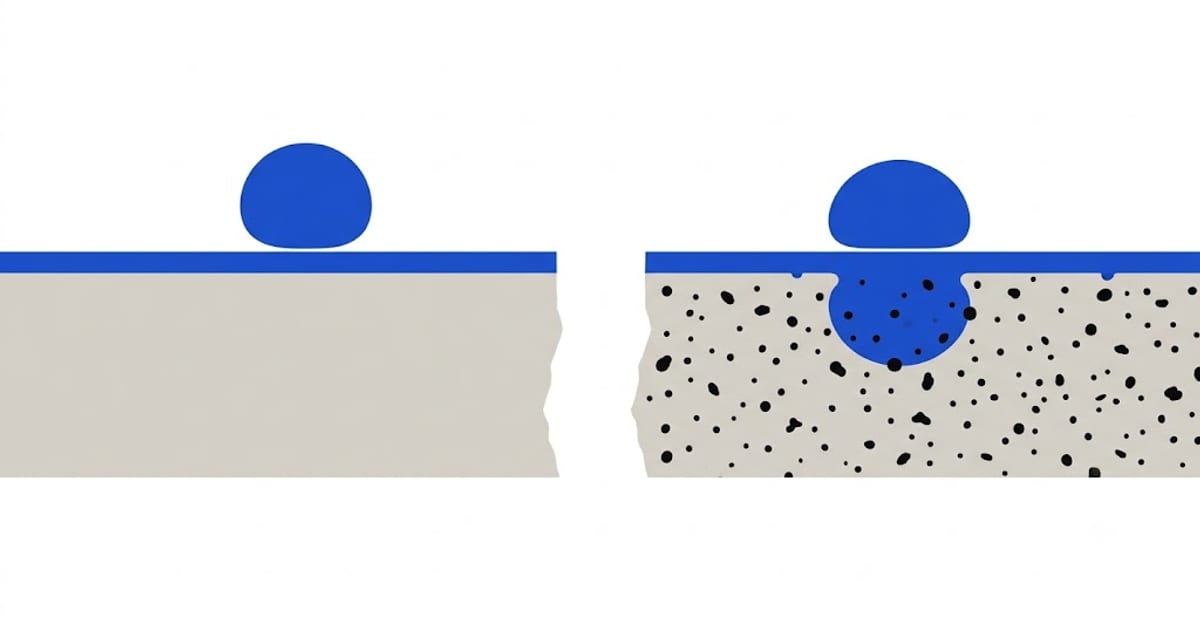
Porcelain is ceramic. The industry distinction is one measured property, defined in ASTM C373:
Porcelain absorbs 0.5% or less of its weight in water. Ceramic absorbs more.
That is the whole definition. Everything else — density, strength, frost resistance, price — follows from it.
What lower absorption gives you
Frost resistance. Water absorbed into a tile expands on freezing and breaks it apart. At 0.5% there is not enough water in the body to matter, which is why exterior and unheated-space tile is porcelain.
Density and strength. Porcelain is fired hotter from finer clay, so the body is denser and breaks less easily under point loads.
Through-body colour on unglazed and full-body porcelain, so a chip does not expose a pale biscuit. Glazed porcelain does not have this — the glaze is still a surface layer.
Stain resistance, because there is very little porosity for anything to soak into.
What ceramic gives you
Lower cost, typically 20 to 50% less.
Easier cutting. Ceramic scores and snaps cleanly with a manual cutter. Porcelain often needs a wet saw, and hard porcelain will defeat a cheap blade.
Lighter weight, which matters on walls and in upper floors.
A wider glaze palette at the low end.
PEI ratings rate the glaze, not the tile
PEI is a surface abrasion rating, and it applies to the glazed surface only:
- PEI 1 — walls only
- PEI 2 — light residential foot traffic, bathrooms
- PEI 3 — all residential floors
- PEI 4 — residential and light commercial
- PEI 5 — heavy commercial
A PEI 5 ceramic will outlast a PEI 3 porcelain underfoot. PEI says nothing about frost resistance, breaking strength or water absorption — those are separate specifications, and people conflate them constantly.
Where each belongs
Porcelain: floors, showers, exteriors, anywhere freezing, high traffic, and anywhere large-format is wanted.
Ceramic: walls, backsplashes, low-traffic interior floors, and any budget-driven interior job that stays dry and warm.
A kitchen backsplash in porcelain is money spent on a property nothing in that location will ever test.
Rectified is a separate question
Rectified means the edges have been mechanically ground square after firing, allowing very tight grout joints. Both ceramic and porcelain can be rectified, and it is a dimensional specification rather than a material one.
If tight joints are the goal, the word to look for is rectified — not porcelain.
Large format needs flatness
Anything over 15 inches on a side needs a substrate flat to within 1/8 inch in 10 feet, back-buttering, and often a levelling clip system.
Large tiles are slightly cupped, and on an uneven floor the corners lip. That is a substrate problem that no amount of thinset fixes.