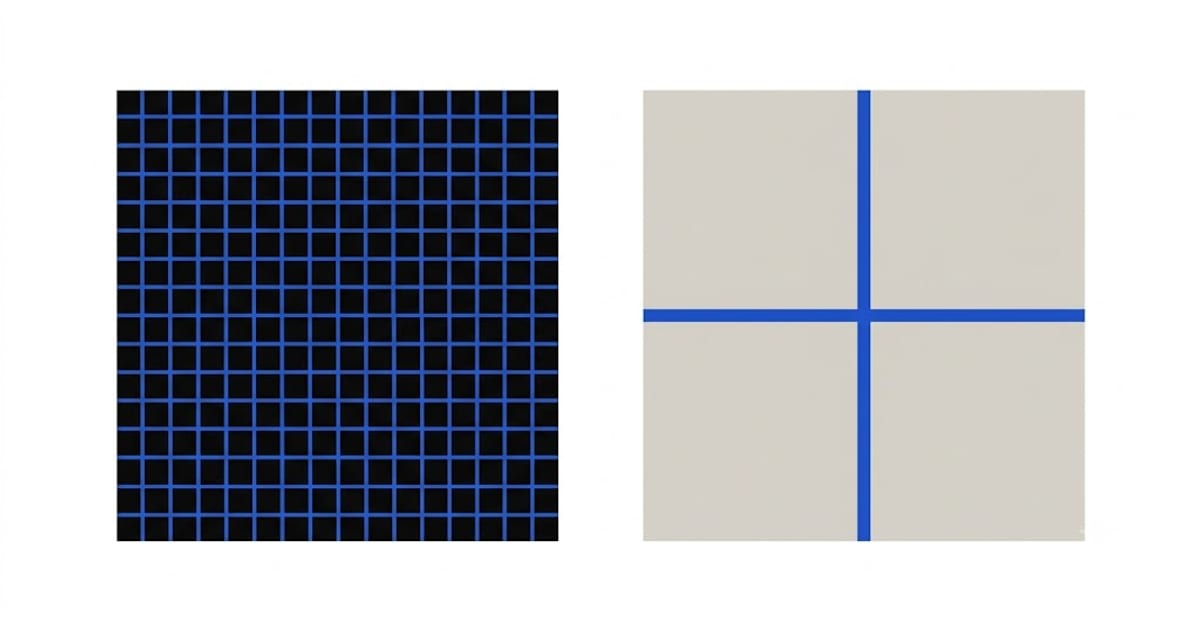
Grout fills the joints, so the quantity depends on how much joint there is — which is set by tile size, joint width and tile thickness, not by floor area alone.
volume ≈ [(L + W) ÷ (L × W)] × joint width × tile thickness × area
with L and W the tile dimensions. The bracketed term is joint length per unit area, and it is where all the variation lives.
Why small tiles drink grout
A 2 × 2 in mosaic has roughly twelve times the joint length per square foot of a 24 × 24 in tile. Same room, same joint width, twelve times the grout.
That is why a mosaic floor needs several bags where a large-format floor of the same size needs one, and why the "coverage per bag" figure on the sack is meaningless without a tile size attached to it.
Coverage per 25 lb bag, 1/8 in joints
| Tile size | Coverage |
|---|---|
| 1 × 1 in mosaic | 20–25 ft² |
| 2 × 2 in | 35–45 ft² |
| 4 × 4 in | 70–85 ft² |
| 6 × 6 in | 100–120 ft² |
| 12 × 12 in | 180–220 ft² |
| 12 × 24 in | 250–300 ft² |
| 24 × 24 in | 350–420 ft² |
Doubling the joint width roughly doubles the requirement. Doubling tile thickness does the same.
Three things that push it up
Tile thickness. A 3/8 in porcelain plank needs half again the grout of a 1/4 in ceramic at the same joint width, because the joint is deeper.
Uneven substrate. Where tiles lip, the joint is deeper on one side and grout fills more.
Unsanded shrinkage. Unsanded grout shrinks as it cures, and joints often need a second pass. Budget an extra 10%.
Sanded or unsanded
The crossover is 1/8 inch. Unsanded at 1/8 and below; sanded at 1/8 and above.
Sanded grout scratches polished stone, glass and some glazes — use unsanded or epoxy there, and test on an offcut first.
Epoxy grout
Stain-resistant, needs no sealing, and works across joint widths. It costs several times as much, has a short working time, and its residue must be removed before it cures — after that it is essentially permanent.
Worth it on kitchen backsplashes, shower floors and anywhere that sees grease or constant water. Not worth it on a bedroom floor.
Never grout a movement joint
Perimeters, changes of plane and every 20 to 25 ft in a field get silicone, not grout. Cement grout in a joint that has to move will crack, and the crack will run through the tile about half the time.
Work the volume for your exact tile and joint on the grout calculator — the tile dimensions matter more than anything else you enter.