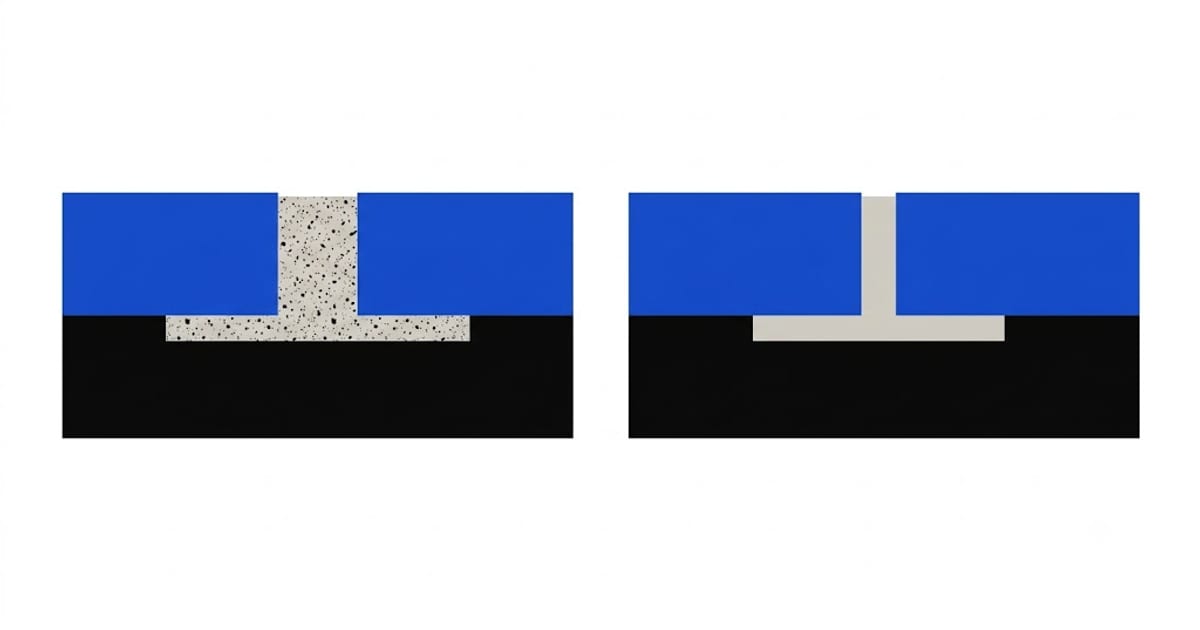
Sanded or unsanded is presented as a choice. It is closer to a rule with a boundary at 1/8 inch, and stepping across it in either direction produces a specific failure rather than a slightly different look.
Quantities for either type come out of the same geometry — see the grout coverage page.
The boundary
| Joint width | Use |
|---|---|
| Under 1/8″ | Unsanded |
| Exactly 1/8″ | Either, depending on the product |
| Over 1/8″ | Sanded |
Manufacturers state their own limits on the bag and some products stretch the boundary in one direction, so the bag wins over the table. But the shape of the rule is consistent across the industry, and the reason is physical.
What goes wrong on each side
Unsanded grout in a wide joint shrinks and cracks. Unsanded grout is cement and pigment with no aggregate. Cement shrinks as it cures. In a narrow joint there is so little material that the shrinkage is negligible; in a wide one there is enough that the grout pulls away from the tile edges or cracks down the middle. The sand in sanded grout is aggregate — it does not shrink, so it holds the volume stable.
Sanded grout in a narrow joint will not pack. The sand grains are simply too large to work down into a 1/16″ slot. You get a joint filled at the surface with a void underneath, which is exactly the failure the main grout page warns about — water gets in and the grout has nothing supporting it.
Neither failure is visible on the day. Both show up in the first year.
The scratching problem
Sanded grout contains hard aggregate, and dragging it across a soft finish during clean-up abrades it.
Surfaces at risk:
- Polished marble and other soft natural stone
- Polished porcelain with a delicate finish
- Glass tile and glass mosaic
- Metal tile and metal trim
Sanded grout on any of those needs either an unsanded alternative sized to the joint, or extreme care during clean-up — and "extreme care" is a poor plan across a whole wall.
The awkward case is a soft stone with joints wide enough to want sanded grout. That is exactly what epoxy and other high-performance grouts exist for: they handle wide joints without the shrinkage problem and without aggregate that will scratch the stone. They cost several times as much per unit volume and set in minutes rather than hours, which is why nobody uses them by default.
What the width should be
Joint width is not free choice either. Three things constrain it:
Tile variation. All tile has a dimensional tolerance, and rectified tile has a tighter one than pressed tile. The joint has to be wide enough to absorb the variation, or the run visibly drifts. Larger tiles have larger absolute variation, so minimum joint width rises with tile size.
Movement. Grout joints are not movement joints, but a wider joint accommodates a little more differential movement between tiles than a hairline one.
The look. Once the first two are satisfied, this is the part you actually get to choose, and it is a bigger visual decision than most people expect — a 1/16″ joint and a 1/4″ joint on the same tile produce genuinely different floors.
Industry guidance from TCNA ties minimum joint width to the tile's measured facial dimension variation rather than to a single universal number, which is the correct way round.
Quantity, briefly
Joint width scales grout volume linearly. Doubling the width doubles the grout, whatever the tile:
| Joint width | Grout relative to 1/8″ |
|---|---|
| 1/16″ | 0.50× |
| 1/8″ | 1.00× |
| 3/16″ | 1.50× |
| 1/4″ | 2.00× |
So the sanded/unsanded decision and the quantity decision are the same decision, arrived at from different directions. If you widen the joint to move into sanded territory, you have also doubled your grout order.
What this page does not cover
- The volume formula and the tile size table are on the grout coverage page.
- Epoxy and urethane grouts have their own width rules and behave differently from cement in every respect.
- Sealing — cement grout is porous and generally wants sealing; most epoxy does not.
- Colour matching between lots is a bigger practical problem than the sanded question, and it is solved by buying everything at once.
One eighth of an inch. Below it unsanded, above it sanded, and on soft stone neither of those is automatically the answer.