Large format tile is unusual: it is the case where the bigger, more expensive product consumes less of a consumable. The saving in grout is not marginal, and it is exactly calculable.
The formula and the full size table are in the grout coverage page.
The figures
Grout volume in cubic inches per 100 square feet of 12 × 24″ tile:
| Tile thickness | 1/16″ joint | 1/8″ joint | 3/16″ joint | 1/4″ joint |
|---|---|---|---|---|
| 5/16″ (porcelain) | 35 | 70 | 105 | 141 |
| 3/8″ (large format) | 42 | 84 | 126 | 169 |
| 1/2″ (stone) | 56 | 112 | 168 | 225 |
Most 12 × 24 porcelain sold today is 3/8″ or a little more, so the middle row is the one to use unless you have measured your own.
Divide by the volume yield printed on the product you are buying to get bags, then add ten percent for waste.
Why it is exactly a quarter less
The joint volume per square foot is governed by (L + W) ÷ (L × W). For 12 × 12 that is 24 ÷ 144 = 0.1667. For 12 × 24 it is 36 ÷ 288 = 0.125.
0.125 ÷ 0.1667 = 0.75.
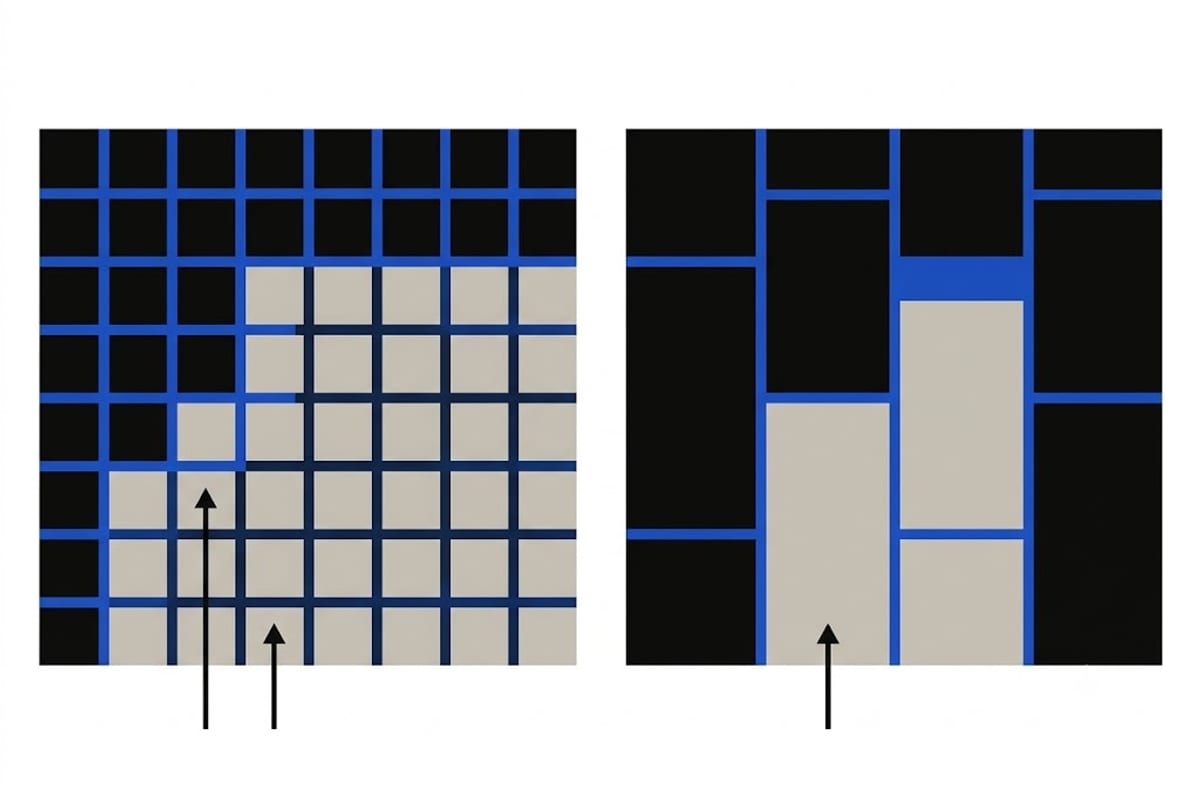
So a 12 × 24 floor needs exactly three quarters the grout of the same area in 12 × 12, at the same joint width and thickness. Going to 24 × 24 halves it. The ratio has nothing to do with the material and everything to do with how much joint perimeter a square foot of floor contains.
But the thickness usually cancels part of it out. Large format tile is normally thicker than small format, and joint depth scales linearly with tile thickness. Going from 5/16″ 12 × 12 to 3/8″ 12 × 24 is 0.75 × 1.2 = 0.90 — a ten percent saving, not twenty-five. Compare thicknesses before you claim the discount.
Joint width on large format
Large format tile is where joint width stops being purely a look decision.
Very narrow joints are risky on big tile. All tile has a manufacturing tolerance on its dimensions, and the absolute variation is larger on a longer tile. A 1/16″ joint has no room to absorb it, and the result is a run that visibly drifts. Industry guidance from bodies such as TCNA is that minimum joint width should increase with tile size and with the tile's measured variation.
Warpage matters more than length. Large format tiles are permitted a small amount of bow along their length. In a running-bond layout where each tile's midpoint meets the next tile's end, that bow shows up as lippage — one edge standing proud of its neighbour. This is why 50 % offset patterns are generally discouraged on long tile and a third or quarter offset is recommended instead.
Neither of those changes the grout volume much. Both change whether the finished floor looks right.
Coverage in practical terms
For a typical bathroom or kitchen floor in 12 × 24 at 3/8″ thick with 1/8″ joints:
| Floor area | Grout volume |
|---|---|
| 40 sq ft | 34 in³ |
| 60 sq ft | 50 in³ |
| 100 sq ft | 84 in³ |
| 150 sq ft | 126 in³ |
| 250 sq ft | 210 in³ |
These are small numbers, and that is the honest headline: most residential 12 × 24 jobs are a one or two bag purchase. The quantity question matters much less here than on a small-format wall, and the decisions that actually matter are joint width, colour lot and whether you have enough working time.
Buy the colour in one lot
Because the quantity is small, the temptation is to buy one bag and get another later if needed. Do not.
Cement grout colour varies between manufacturing lots. A joint filled from a second bag weeks later will not match, and on a floor that difference is visible under raking light forever. Buy the whole quantity at once, in one purchase, and keep the remainder sealed for repairs. One extra bag is the cheapest insurance on the job.
What this page does not cover
- The derivation of the volume formula is in the main grout page.
- Thinset coverage is a separate calculation driven by trowel notch size, and large format tile needs a bigger notch and often back-buttering.
- Substrate flatness is the real constraint on large format. The longer the tile, the less floor deviation it can bridge before lippage appears, and the flatness tolerance tightens as tile size grows.
- Epoxy grouts have very different working times and cost, though the geometry is identical.
Three quarters the grout of 12 × 12 on paper, about ninety percent of it in practice once thickness is accounted for.