
Tile is not waterproof and neither is grout. Cement grout is porous by design, and a tile bed passes water readily. In every shower ever built, water gets behind the tile.
The waterproofing is the layer that stops it there and directs it back to the drain.
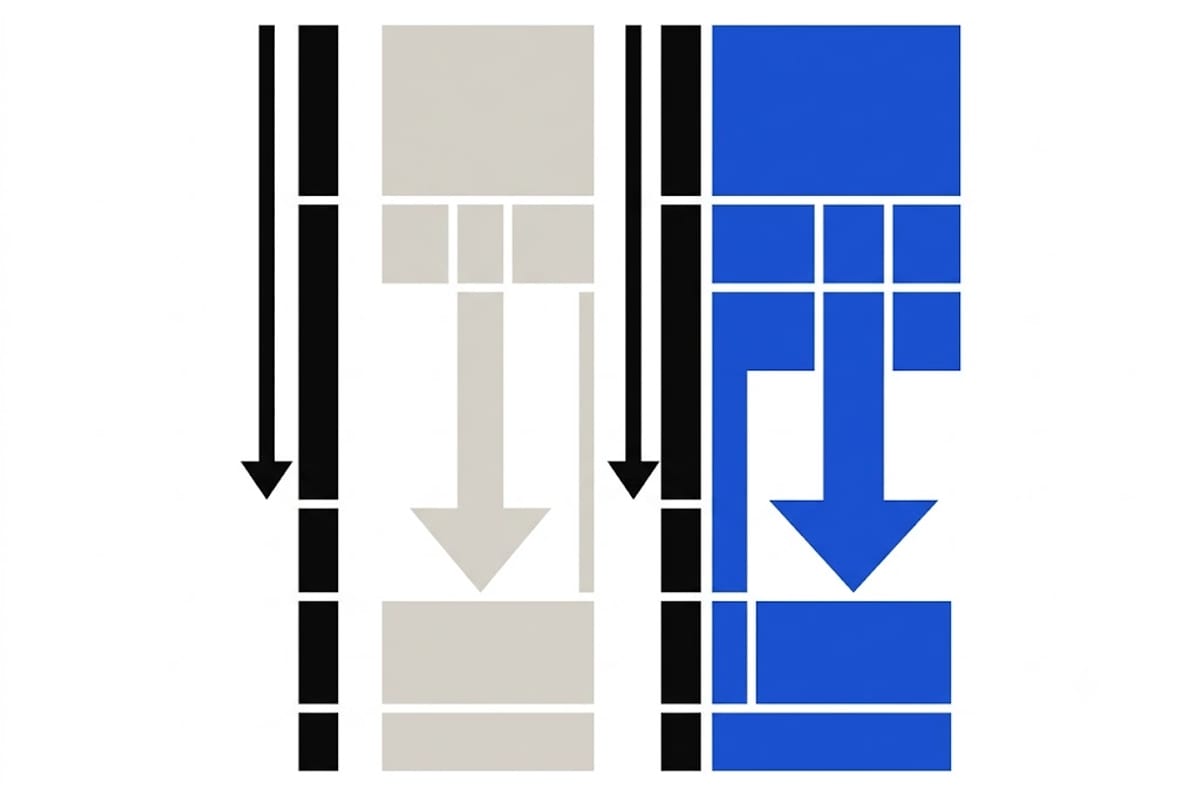
Two systems, and they work in opposite directions
Traditional mud bed with a clamping drain. A PVC or CPE pan liner sits on a pre-sloped mortar bed, turns up the walls, and clamps into a two-part drain. Water passes through the tile and the upper mortar bed, reaches the liner, runs down the slope, and exits through weep holes in the drain body.
The pre-slope is not optional and it is the most commonly omitted step. A liner laid flat holds a permanent pool of water under the tile. The floor still drains at the surface, so nothing looks wrong for years.
Bonded membrane over a sloped substrate. A sheet or liquid membrane meeting ANSI A118.10 is applied directly to the sloped surface, and the tile is bonded to the membrane. Water never gets past the membrane at all, so there is no second drainage plane and no weep holes to block.
These are two complete systems. Mixing them — a bonded membrane over a pan liner, or a clamping drain under a bonded system — produces water trapped between two waterproof layers with nowhere to go.
Sheet or liquid
Sheet membranes are consistent in thickness because the thickness is manufactured rather than applied. The work is in the seams and the corners, which need the manufacturer's banding and preformed pieces.
Liquid membranes conform to any shape, which makes benches, niches and curbs easier. The risk is thickness: they must be applied to a specified wet-film thickness, usually in two coats, and a thin spot is invisible once dry. Use the manufacturer's gauge and coverage rate rather than judging by eye.
Both work. Neither works when mixed with another manufacturer's system, and every warranty says so.
Where showers actually leak
Almost never through the field of the wall. Nearly always at a transition:
- The curb, especially the inside corner where it meets the floor
- The niche, where a shelf creates a horizontal surface and four corners
- Corners generally, if preformed pieces were skipped
- The drain connection, if the clamping ring was not tightened evenly or the liner was cut short
- Penetrations for the mixing valve and the shower arm
Each of these needs the manufacturer's specific detail. This is where the work happens and where the failures are.
Flood test before any tile goes on
Plug the drain, fill the pan to just below the top of the curb, mark the water level, and leave it 24 hours. Check the level and check the ceiling below.
This is the single most valuable hour in the whole bathroom, and it is the one that cannot be repeated once tile is set. A tiler who resists it is telling you something.
What backer board does and does not do
Cement board is not waterproof. Water passes through it freely — it simply does not deteriorate when it does, which is why it beats drywall in a wet area.
Behind cement board there must be either a vapour retarder in the stud cavity or a waterproof membrane on the face of the board. Not both. A membrane on the face and poly behind the board traps water inside the wall, and that is a wall that never dries.
Foam backer boards with an integral waterproof face are a third approach and a good one, provided the seams and screw penetrations are sealed with the manufacturer's sealant.
The question to ask before work starts
"Which waterproofing system, and can I see the flood test?" A contractor who names a manufacturer and a method, and expects to flood test, is doing the job. One who says the tile and grout will keep the water out is describing something that has never been true.