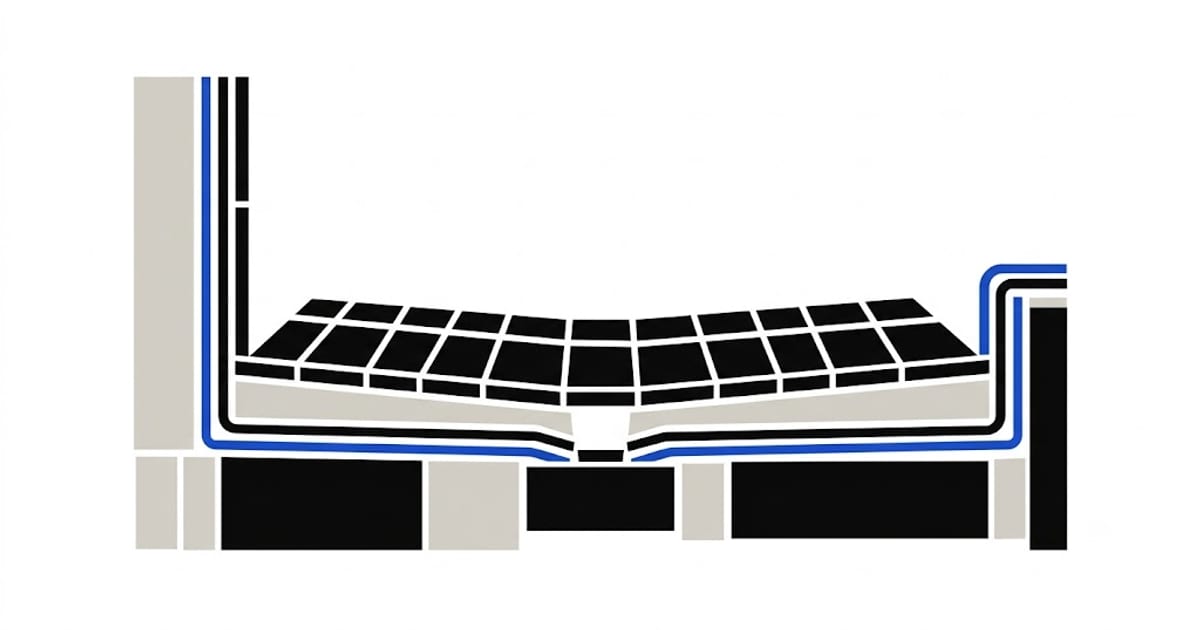
Tile is not a waterproofing layer. Neither is grout, and neither is thinset. Water passes through all three by capillary action and vapour drive, and a shower that has been running for ten minutes has wet mortar behind it.
The waterproofing is a separate layer, and its job is to catch that water and route it to the drain.
Three approaches
Sheet membranes — bonded polyethylene sheets (Schluter Kerdi and equivalents) adhered to the substrate with thinset, seams overlapped and sealed. Waterproof immediately, inspectable, and the most forgiving to install correctly. The seams and corners are where they fail.
Liquid-applied membranes — rolled or brushed on in coats (RedGard, Hydro Ban and equivalents). Fast on complex geometry with no seams to get wrong, and the failure mode is thickness: they must reach the specified wet-film thickness, which usually means more coats than people apply. Use a wet-film gauge, not judgement.
Traditional mortar bed with a PVC or CPE liner — a liner under a sloped mortar bed, draining through a weep-hole drain. Long-established, still specified, and it works. It also depends entirely on the pre-slope.
The pre-slope, and why it is not optional
In a traditional liner system, water reaches the liner, not the tile surface. If the liner sits flat, water sits on it, permanently, under the mortar bed.
So the substrate under the liner must already slope to the drain — a pre-slope — before the liner goes down. The mortar bed above then slopes again.
Skipping the pre-slope is the single most common shower failure in older construction. It does not leak in the usual sense; it holds standing water indefinitely, and the first symptom is a smell.
Slope
1/4 inch per foot to the drain, minimum. Measure from the furthest corner of the pan.
Curbs slope inward. Niches slope outward. Benches slope forward, at the same 1/4 in per foot.
Corners and penetrations
Almost all membrane failures are at changes of plane and at holes.
Pre-formed inside and outside corners for sheet systems. Reinforcing fabric bedded into the first coat for liquid systems. Sealant-and-collar assemblies at the mixing valve and shower arm.
A flat run of membrane rarely fails. A corner folded rather than pre-formed usually does.
Flood test before tiling
Plug the drain, fill the pan to the top of the curb, mark the water line, and leave it 24 hours.
If the level drops, find the leak now — while the membrane is exposed and the repair is an afternoon. After tiling, the same repair means demolition.
This test takes a day and it is the highest-value day in the whole job. Skipping it is how a leak gets buried.
Vapour, not just liquid
In a steam shower the requirement changes: a vapour-retarder membrane is needed as well, and the ceiling has to be sloped and waterproofed too. A standard shower assembly used as a steam shower fails from the inside out.