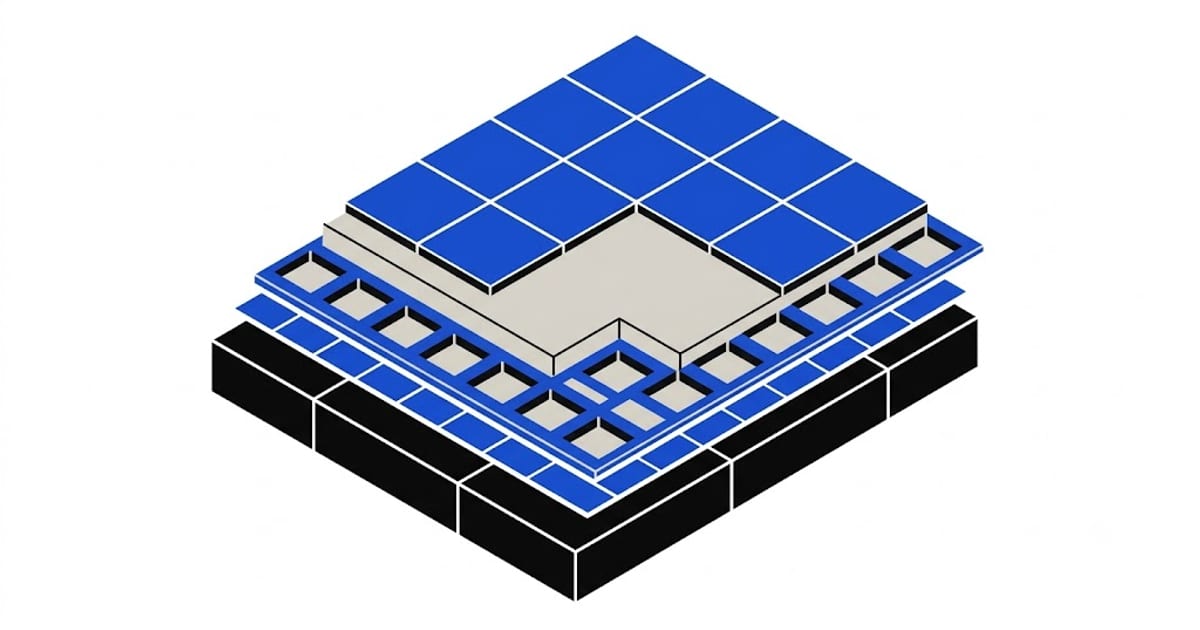
Under a tiled floor there may be a membrane, a board, a levelling compound, or all three. They are not alternatives — each addresses a different failure.
Uncoupling membranes — for movement
Ditra and its equivalents are dimpled polyethylene sheets that let the tile and the substrate move independently. The tile bonds into the dimples; the fleece backing bonds to the substrate; the two are mechanically separated in the plane of the floor.
Solves: in-plane movement — a plywood subfloor shrinking seasonally, new concrete still curing and shrinking, thermal movement over in-floor heating.
Does not solve: deflection. A bouncy floor is bouncy under a membrane.
Note the mortar requirement: most uncoupling membranes want unmodified thinset above them, because a polymer mortar sandwiched between two non-porous layers cannot cure. This is one of the most common and most expensive tiling errors, and the symptom appears months later.
Cement backer board — for a bondable, water-tolerant surface
Cement and fibreglass mesh. Unaffected by water, though not waterproof.
Solves: giving tile a stable, water-tolerant surface to bond to over plywood or framing.
Does not solve: deflection, meaningfully. Backer board adds very little stiffness — a second layer of plywood does far more for a bouncy floor.
Self-levelling compound — for flatness
A pourable cementitious mix that finds its own level.
Solves: substrate flatness, which for large-format tile must reach 1/8 in in 10 ft.
Essential where large tile meets an ordinary floor, and the step people skip before discovering lippage they cannot fix.
Crack isolation membranes — for existing cracks
Sheet or liquid membranes rated to ANSI A118.12, designed to bridge an existing crack of a stated width so it does not telegraph through.
Solves: shrinkage cracks in a slab that are not moving.
Does not solve: a structural crack. If the two sides of a crack are at different heights, or the crack is growing, that is an engineering question and tiling over it just hides it while it continues.
Deflection is the one none of them fix
Tile fails from flex. The requirement is L/360 for ceramic and porcelain, L/720 for natural stone.
Meeting it is a framing and subfloor question: joist size and spacing, and subfloor thickness. Adding a second layer of plywood, sistering joists, or adding a mid-span beam are the real fixes.
Nothing in this list stiffens a floor. If it bounces when you walk across it, fix that first — everything else is optimising the finish on a floor that will crack anyway.